
HL7 Europe publishes new Implementation Guides (Base and Core, Laboratory report and Hospital discharge report) for EHDS priority categories of health data
Brussels, 16 October 2026 — HL7 Europe has published new HL7 Europe Implementation Guides that support the interoperable exchange of health information across Europe and contribute to the broader European interoperability ecosystem, including the European Health Data Space (EHDS) and cross-border health data exchange initiatives. The Guides include:
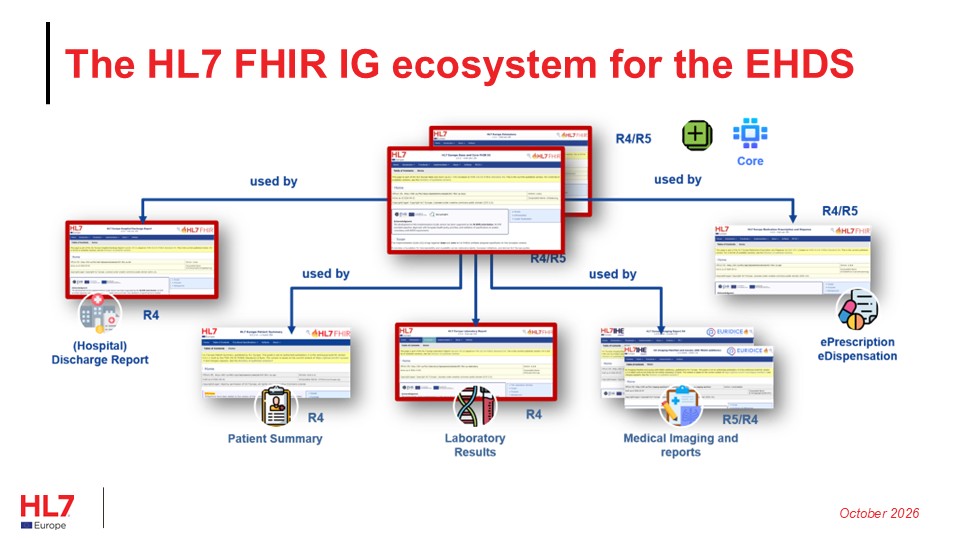
- HL7 Europe Laboratory Report HL7 FHIR Implementation Guide version 2.1.0, for laboratory information. Building on version 2.0, this new release introduces additional capabilities, corrections, and refinements aimed at improving consistency, implementability, and alignment with European interoperability requirements. The full guide is available at https://hl7.eu/fhir/laboratory/ (change log here).
- HL7 Europe Hospital Discharge Report HL7 FHIR Implementation Guide version 1.0.0, the first Standard for Trial Use (STU) release of this specification, based on HL7 FHIR R4. This guide provides a common European framework for representing hospital discharge reports using HL7 FHIR, supporting the harmonisation of national initiatives and preparing the ground for the European Electronic Health Record Exchange Format (EEHRxF), in the context of the European Health Data Space (EHDS). The full guide is available at https://hl7.eu/fhir/hdr/ (change log here).
- HL7 Europe Extensions FHIR Implementation Guide version 1.3.1, adopting technical corrections on version 1.3. The full guide is available at https://hl7.eu/fhir/extensions/ for both R4 and R5 (change log here).
- HL7 Europe Base and Core HL7 FHIR Implementation Guide version 2.0.1, offering technical corrections, enhancements and clarifications on version 2.0. The full guide is available at https://hl7.eu/fhir/base/ for R4 and https://hl7.eu/fhir/base-r5/ for R5 (change log here).
These Guides deliver significant updates and refinements, including improved profiles, terminology, examples, and implementation guidance. They strengthen consistency across European specifications and support EHDS implementation through alignment with the latest available EHDS logical models and improved model-to-profile mappings.
“These Implementation Guides represent another step forward in developing the HL7 Europe FHIR ecosystem for the EHDS,” says Giorgio Cangioli, HL7 Europe Technical Lead. “We continue to align our guides with the latest available EHDS logical models and remain committed to their ongoing maintenance and improvement, supporting the evolution of the European Electronic Health Record Exchange Format (EEHRxF). This was a broad collaborative effort involving more than 200 contributors from 29 countries worldwide, and I would like to thank them all for their dedication, expertise, and continued support.”
HL7 Europe invites the community to explore the guides, provide feedback, and contribute to their continuous improvement. Contact the HL7 Europe Technical Coordination Team (TNT) at info@hl7europe.org and put “TNT” in the subject line.
About HL7 Europe: HL7 Europe is a not-for-profit Foundation established in Brussels in 2010 with the aim to address European standardisation requirements in digital health serving as the European office of HL7 International. The mission of HL7 Europe is to provide standards that empower global health data interoperability to realise its vision of a world in which everyone can securely access and use the right health data when and where they need it. It works in close cooperation with 23 national HL7 Affiliates across Europe and supports the creation of health information technology standards that are widely and easily used enabling interoperability in healthcare.